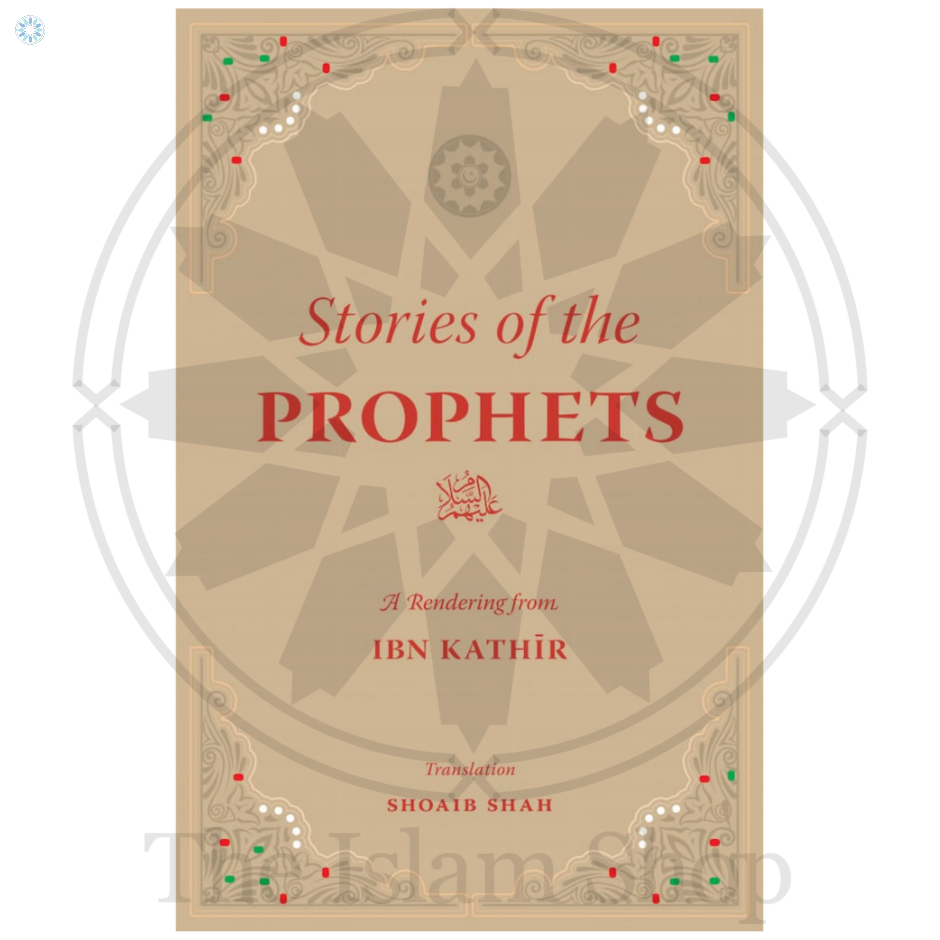
Stories of the Prophets A Rendering from Ibn Kathir
Stories of the Prophets A Rendering from Ibn Kathir
Imam ‘Imad ad-Din Abu’l-Fida Isma’il ibn Umar ibn Kathir (Author)
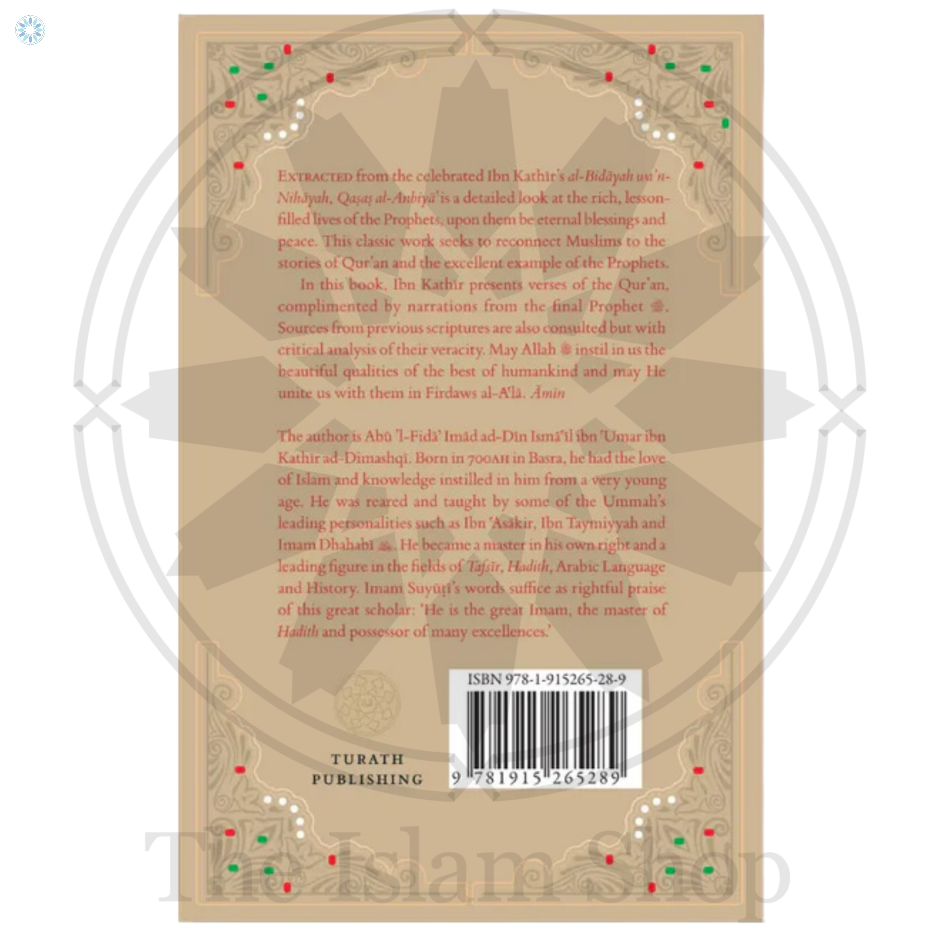
Unlock the timeless wisdom and profound lessons of the Prophets with Stories of the Prophets: A Rendering from Ibn Kathir. Extracted from the celebrated classical work al-Bidayah wa'n-Nihayah (Qasas al-Anbiya), this invaluable book offers an in-depth look at the lives of the Prophets, peace and blessings be upon them. These sacred stories, beautifully narrated by one of Islam’s greatest scholars, Ibn Kathir, serve as a powerful reminder of the divine guidance, patience, and perseverance exemplified by these noble figures.
This essential text reconnects readers to the stories of the Qur’an, shedding light on the exemplary lives of the Prophets, their trials, and their unwavering faith. Ibn Kathir masterfully combines Qur'anic verses with hadiths from the final Prophet ﷺ, along with critical analysis of sources from earlier scriptures, ensuring an authentic and scholarly exploration of these pivotal figures.
As you delve into these inspiring accounts, allow the profound teachings of the Prophets to strengthen your understanding of Islam and ignite a renewed connection to your faith. This book not only nurtures spiritual growth but also helps us embody the noble qualities that were embodied by the Prophets themselves.
With each page, you’ll be inspired to reflect on the challenges faced by these extraordinary individuals, their trust in Allah’s plan, and their dedication to spreading His message. Stories of the Prophets is a must-have addition to any Muslim’s library, providing a deeper appreciation of our beloved Prophets and guiding us toward emulating their righteous ways.
Key Features
- A comprehensive rendering of the lives of the Prophets, peace be upon them
- Direct quotes from the Qur'an, Hadiths, and critical analysis of previous scriptures
- Inspiring lessons that guide us towards developing noble character traits
- A beautifully crafted text that brings the teachings of Islam to life
Let the wisdom of the Prophets inspire you to lead a life of integrity, faith, and devotion. Stories of the Prophets is more than just a book—it’s an invitation to walk in the footsteps of those who have illuminated the path before us.
Order your copy today and deepen your connection with the divine message. May Allah (swt) grant us the ability to embody the qualities of the best of mankind and unite us with them in Firdaws al-A’la. Ameen.
About The Author
Imam Ibn Kathir (Abū al-Fiḍā’ ‘Imād ad-Dīn Ismā‘īl ibn ‘Umar ibn Kathīr al-Qurashī al-Damishqī)
Abū al-Fiḍā’ ‘Imād ad-Dīn Ismā‘īl ibn ‘Umar ibn Kathīr al-Qurashī al-Damishqī (إسماعيل بن عمر بن كثير القرشي الدمشقي أبو الفداء عماد; c. 1300 – 1373), known as Ibn Kathīr (ابن كثير), was a highly influential Arab historian, exegete and scholar during the Mamluk era in Syria. An expert on tafsir (Quranic exegesis) and fiqh (jurisprudence), he wrote several books, including a fourteen-volume universal history titled Al-Bidaya wa'l-Nihaya.
His tafsir is recognized for its critical approach to Israʼiliyyat, especially among Western Muslims and Wahhabi scholars. His methodology largely derives from his teacher Ibn Taymiyyah, and differs from that of other earlier renowned exegetes such as Tabari. For that reason, he is mostly considered an Athari, despite being a Shafi'i jurist.
His full name was Abū l-Fidāʾ Ismāʿīl ibn ʿUmar ibn Kaṯīr (أبو الفداء إسماعيل بن عمر بن كثير) and had the laqab (epithet) of ʿImād ad-Dīn (عماد الدين "pillar of the faith"). His family trace its lineage back to the tribe of Quraysh. He was born in Mijdal, a village on the outskirts of the city of Busra, in the east of Damascus, Syria, around about AH 701 (AD 1300/1). He was taught by Ibn Taymiyya and Al-Dhahabi.
Upon completion of his studies he obtained his first official appointment in 1341, when he joined an inquisitorial commission formed to determine certain questions of heresy.
He married the daughter of Al-Mizzi, one of the foremost Syrian scholars of the period, which gave him access to the scholarly elite. In 1345 he was made preacher (khatib) at a newly built mosque in Mizza, the hometown of his father-in-law. In 1366, he rose to a professorial position at the Great Mosque of Damascus.
In later life, he became blind.[17] He attributes his blindness to working late at night on the Musnad of Ahmad Ibn Hanbal in an attempt to rearrange it topically rather than by narrator. He died in February 1373 (AH 774) in Damascus. He was buried next to his teacher Ibn Taymiyya
The records from modern researchers such as Taha Jabir Alalwani, Yazid Abdu al Qadir al-Jawas, and Barbara Stowasser has demonstrated important similarities between Ibn Kathir and his influential master Taqi al-Din Ibn Taymiyyah, such as rejecting logical exegesis of Qur'an, advocating a militant jihad and adhering to the renewal of one singular Islamic ummah. Furthermore, these scholars assert that like Ibn Taymiyyah, Ibn Kathir is to be categorised as an anti-rationalistic, traditionalistic and hadith oriented scholar. According to Jane McAuliffe in regards of Qur'anic exegesis, Ibn Kathir uses methods contrary to former Sunni scholars, and followed largely the methodology of Ibn Taymiyyah. Barbara Freyer contends that this anti-rationalistic, traditionalistic and hadith oriented approaches held by Ibn Kathir were shared not only by Ibn Taymiyyah,but also by Ibn Hazm, Bukhari independent Madhhab, and also scholars from Jariri, and Zahiri Maddhabs. According to Christian Lange, although he was a Shafi, he was closely aligned with Damascene Hanbalism. 86 David L. Johnston described him as "the traditionist and Ash'arite Ibn Kathir".
Taha Jabir Alalwani, Professor and President of Cordoba University in Ashburn, Virginia maintains that these traditionalistic views of Ibn Kathir claimed by Salafists were rooted further to the generation of Sahaba Salaf, where Zubayr ibn al-Awwam, one of The ten to whom Paradise was promised also taught this view. Contemporary researchers notes that these anti rationalistic, anti Ash'arite methods of Ibn Kathir shared with his teacher Ibn Taimiyyah; were proven in his tafseer regarding the Day of Resurrection and Hypocrisy in Qur'an.
Ibn Kathir states:
"People have said a great deal on this topic and this is not the place to expound on what they have said. On this matter, we follow the early Muslims (salaf): Malik, Awza'i, Thawri, Layth ibn Sa'd, Shafi'i, Ahmad ibn Hanbal, Ishaq Ibn Rahwayh, and others among the Imams of the Muslims, both ancient and modern that is, to let (the verse in question) pass as it has come, without saying how it is meant (min ghayr takyif), without likening it to created things (wa la tashbih), and without nullifying it (wa la ta'til): The literal meaning (zahir) that occurs to the minds of anthropomorphists (al-mushabbihin) is negated of Allah, for nothing from His creation resembles Him: "There is nothing whatsoever like unto Him, and He is the All-Hearing, the All-Seeing" Rather this affair is like what the Grand Shaykh of Imam Bukhari Shaykh Naeem ibn Hamaad Khazaa'i said "Whosoever likens Allah to his Creation has done Kufr (disbelieved) and whosoever negates what Allah describes Himself with has also done Kufr (Disbelieved) There is nothing with what Allah describes Himself with nor his Prophet describes Allah with from likening Allah to his Creation (tashbeeh). Whosoever affirms for Allah what has reached Us from the Truthful Ayahs (verses) and Correct Hadeeth (Prophetic narrations) on the way that is befitting the Majesty of Allah while negating from Allah all defects indeed He has traveled the way of guidance." (Tafsir Ibn Kathir 7:54)
Ibn Kathir wrote a famous commentary on the Qur'an named Tafsīr al-Qurʾān al-ʿAẓīm better known as Tafsir Ibn Kathir which linked certain Hadith, or sayings of Muhammad, and sayings of the sahaba to verses of the Qur'an, in explanation and avoided the use of Isra'iliyyats. Many Sunni Muslims hold his commentary as the best after Tafsir al-Tabari and Tafsir al-Qurtubi and it is highly regarded especially among Salafi school of thought.[41] Although Ibn Kathir claimed to rely on at-Tabari, he introduced new methods and differs in content, in attempt to clear Islam from that he evaluates as Isra'iliyyat. His suspicion on Isra'iliyyat possibly derived from Ibn Taimiyya's influence, who discounted much of the exegetical tradition since then.
His Tafsir has gained widespread popularity in modern times, especially among Western Muslims, probably due to his straightforward approach, but also due to lack of alternative translations of traditional tafsirs. Ibn Kathir's Tafsir work has played major impact in the contemporary movements of Islamic reform. Salafi reformer Jamal al-Din Qasimi's Qurʾānic exegsis Maḥāsin al-taʾwīl was greatly influenced by Ibn Taymiyya and Ibn Kathīr, which is evident from its emphasis on ḥadīth, Scripturalist approaches, the rejection of Isrāʾīliyyāt, and a polemical attitudes against the Ahl al-raʾy. From the 1920s onwards, Wahhabi scholars also contributed immensely to popularisation of ḥadīth-oriented hermeneutics and exegeses, such as Ibn Kathīr's and al-Baghawī’s Qurʾān commentaries and Ibn Taymiyya’s al-Muqaddima fī uṣūl al-tafsīr, through printing press. The Wahhābī promotion of Ibn Taymiyya’s and Ibn Kathīr’s works through print publishing during the early twentieth century emerged instrumental in making these two scholars popular in the contemporary period and imparted a robust impact on modern exegetical works.
In academic discourse
Tafsīr al-Qurʾān al-ʿAẓīm is controversial in western academic circles. Henri Laoust regards it primary as a philological work and "very elementary". Norman Calder describes it as narrow-minded, dogmatic, and skeptical against the intellectual achievements of former exegetes. His concern is limited to rate the Quran by the corpus of Hadith and is the first, who flatly rates Jewish sources as unreliable, while simultaneously using them, just as prophetic hadith, selectively to support his prefabricated opinion.Otherwise, Jane Dammen McAuliffe regards this tafsir as "deliberately and carefully selected, whose interpretation is unique to his own judgment to preserve, that he regards as best among his traditions."
About The Publishers
White Thread Press
White Thread Press is a leading Islamic book publisher dedicated to preserving and sharing authentic Islamic knowledge based on the Qur'an and Sunnah. Known for its high-quality Islamic books and scholarly publications, White Thread Press offers a wide range of Sunni Islamic books that combine classical Islamic scholarship with contemporary relevance.
At The Islam Shop, we carefully select books from Turath Publishing to provide our customers with trusted Islamic literature, authentic Islamic books, and reliable resources for Islamic learning. Their collection includes books on Hadith, Tafsir, Aqeedah, Fiqh, Islamic history, Seerah, spirituality, and personal development, helping readers strengthen their understanding of Islam and grow in faith.
Whether you are looking for educational Islamic books, Islamic study resources, Muslim books for beginners, or advanced scholarly works, White Thread Press offers valuable guidance for students of knowledge and anyone seeking a deeper connection to their faith through authentic Islamic teachings.
Turath Publishing
Turath Publishers is a respected name in Islamic publishing, producing authentic Islamic books rooted in the Qur'an and Sunnah. Their collection combines classical scholarship with contemporary learning, offering trusted resources in Islamic studies, Hadith, Seerah, Aqeedah, and spirituality. At The Islam Shop, we carefully curate books from leading Islamic publishers to provide reliable Islamic literature for readers across the UK. Whether you are seeking Sunni Islamic books, educational resources, or inspirational guidance, explore our range of trusted Islamic books from Turath Publishers to strengthen your Islamic knowledge, faith, and lifelong journey of Islamic learning.
Additional Product Information
- Author: Imam Ibn Kathir (Abū al-Fiḍā’ ‘Imād ad-Dīn Ismā‘īl ibn ‘Umar ibn Kathīr al-Qurashī al-Damishqī)
- Publisher: White Thread Press / Turath Publishing
- Publication: May Vary from batch
- Edition: First English Edition
- Format: Print Book
- Binding: Paperback
- Pages: 509
- Dimensions: Approx. 5 × 8 inches (12.7 × 20.3 cm)
- Language: English
- Genre: Islamic History, Stories of the Prophets, Classical Islamic Literature
- Category: Qur'anic Studies / Stories of the Prophets / Islamic History
- ISBN-13: 9781915265289
- Translator: Shoaib Shah
- Editor: N/A
- Illustrator: N/A
- Suitable Age: 10+ (Suitable for Teens & Adults)
- Grade / Level: Beginner to Advanced
- Country of Publication: Turkey
Share
You may also be interested in
-
 Prophet Of Mercy Nabiyy-i Rahmat
This book is an English translation of as-Sirat an-Nabawiyyah; a scholarly and thoroughly researched Arabic work of Shaykh Abul-Hasan Ali Nadwi (May Allahs Mercy be upon him). However the title has been taken from t...
£14.00 -
From the Beginning to the End [Islamic History]
An abridged Engligh translation of The Classical work Al-Bidayah wa 'l-Nihayah (The Beginning and the End) or Tarikh ibn Kathir (The history [book of] Ibn Kathir) one of the most comprehensive sources of Islamic his...
£72.99 -
The Path To Perfection - A Spiritual Anthology An Anthology of the Spiritual Teachings of Hakim al-Umma Mawlana Ashraf Ali Thanawi
An Anthology of the Spiritual Teachings of Hakim al-Umma Mawlana Ashraf Ali Thanawi At a time when the discourse surrounding Islam is generally inauthentic and shallow, The Path to Perfection presents a much-need...
£5.99 -
Stories of the Prophets
In this book, the stories of the prophets have been compiled from 'Al-Bidayah wan-Nihayah' (The Beginning and the End) which is a great work of the famous Muslim exegete and historian Ibn Kathir and has a prominent...
£17.00 -
Essentials of Islamic Spirituality
Discover Essentials of Islamic Spirituality by Shaykh Masihullah Khan. Authentic Islamic guidance for spiritual growth, faith, and purification.
£5.99 -
Ascent to Felicity A Manual on Islamic Creed and Hanafi Jurisprudence
Written by the eminent 11th century Hanafi scholar, Abu ’l-Ikhlas al-Shurunbulali, Ascent to Felicity is a concise yet comprehensive primer in creed and jurisprudence. It spans all five pillars of Islam, as well as...
£10.00 -
Gateway to the Qur'anic Sciences Based on al-Itqān fī ʿUlūm al-Qurʾān
Allah describes the Qurʾān as the ‘guidance to mankind, and the Criterion (of right and wrong)’ (2:185). Islamic scholars have therefore sought to explain the sciences associated with correctly understanding the rev...
£4.50 -
A Tentative Guide to Islamic Invocations
This is a rich personal selection of invocations by the esteemed author, all of which are either attributed to the Prophet Muhammad (Allah bless him and give him peace) or to his immediate Companions. In other words...
£6.99 -
Winning The Hearts & Souls
Darussalam is proud to present the abridged English translation of the classic work Al-Bidayah wan Nihayah, focusing exclusively on the delegations and expeditions undertaken in the lifetime of Prophet Muhammad (pea...
£12.95 -
Fortress Of The Muslim [Pocket Size Edition]
Making Dua to Allah frequently and with full submission has many benefits - it increases Imaan, gives hope and relief to the distressed, and saves the supplicant from despair and isolation. In the Qur'an, Allah enco...
£2.95 -
Provisions for the Seekers (Zad al-Talibin) A Manual of Prophetic Hadiths with Commentary
This book is a collection of 327 hadiths which the author, Shaykh ‘Ashiq Ilahi al-Bulandshehri, compiled from ‘Allama Tabrizi’s renowned hadith compilation, Mishkat al-Masabih. The book contains many jawami’ al-kali...
£8.00 -
Qasas al-Anbiya (Arabic) قصص النبياء لبن كثير
Hafiz Ibn Kathir's Qasas al-Anbiya' one of the most authentic works on the subject. Edited and annotated by Ahmad Mahmud al-Khuli. Ahmad Abd al-Fattah Tammam & Samir Husayn Halabi.
£15.00 -
Qawa'id Fi Ulum al-Hadith (Principles of Hadith)
The importance of hadith as the basis of Islamic law, theology and ethics cannot be underestimated. Alongside the Quran it constitutes the second source for Islamic shariah and ones practice. While no Muslim will ch...
£10.00 -
The Muwatta of Imam Muhammad
Imam Malik composed the Muwatta over a period of forty years to represent the well-trodden path of the people of Madina. Its name also means that it is the book that is many times agreed upon about whose contents th...
£13.00 -
The Creed of Imam Bayhaqi
Allah (swt) says in the Qurʾān ﴾Say: We believe in Allah and what has been sent down to us﴿ (2:136). Therefore it is understood by the scholars of Islam that the ‘first obligation’ for a responsible adult is to know...
£9.99 -
Living as a Muslim
Allah (swt) has declared in the Qur’ān: ﴾O you who believe, obey Allah and obey the Messenger…﴿ (4:59). Accordingly, Islamic religious life is based on the instructions of the Qur’ān and the authentic Sunna. This tr...
£6.99
.png|/storage/40d70595_Prophet Of Mercy Nabiyy-i Rahmat (1).png)
![From the Beginning to the End [Islamic History]](/storage/40740584_From The Begining to the End Set.JPG|/storage/40a20588_From The Begining to the End Set.JPG)


.png|/storage/40d40596_Essentials of Islamic Spirituality (2).png)
.png|/storage/40d70598_Ascent to Felicity A Manual on Islamic Creed and Hanafi Jurisprudence (3).png)


![Fortress Of The Muslim [Pocket Size Edition]](/storage/40810587_Fortreess of The Muslims.PNG|/storage/40af058b_Fortreess of The Muslims.PNG)

 (4).png|/storage/40d30596_Qawa'id Fi Ulum al-Hadith (Principles of Hadith) (4).png)
.png|/storage/40d60595_The Muwatta of Imam Muhammad (3).png)
.png|/storage/40bc058a_The Creed of Imam Bayhaqi (3).png)